Couples Card Games: What to Pick for Your Vibe

A couples card game is worth buying when it gives the two of you something to say that you would not have said otherwise. That is the whole test. Most decks fail it in one of two ways: they are party games wearing a couples sticker, so every prompt secretly assumes six friends and a bottle of wine, or they open at full intensity and the very first card asks something neither of you is ready for at 9pm on a Tuesday. Pick by the evening you actually want, not by the loudest promise on the box.
What makes a couples card game actually work?
A couples card game works when it is written for two players, paces itself, and lets either of you pass without it turning awkward. Two-player design shows up in small details: prompts phrased directly to your partner, no team scoring, no need for a referee.
Pacing means the deck has an order or levels instead of one flat pile where a gentle question sits next to a bold dare. The pass rule matters more than people expect, because a game you cannot decline stops being a game the second one card lands wrong. Ben and I learned that on an old party deck with no skip option: card four ended our evening. If a deck’s marketing leans harder on its box art than on what is printed inside, that tells you something.
Low pressure is not a soft extra. In a 2014 study in Personal Relationships of 196 individuals and 83 couples, shared activities that felt satisfying, stress-free and closeness-building predicted higher relationship quality at the time and three months later. The benefit depended on both partners being invested, so a deck one of you gets dragged through will not do much.
Match the deck to the vibe you want
The fastest way to choose a couples card game is to name tonight first, then buy backwards from it. Here is the short version, with the page on this site that goes deeper on each.
| Your vibe tonight | What to look for in the deck | Start here |
|---|---|---|
| We want to talk properly | Open questions, no timer, no scoring | Question games for couples |
| We want to laugh | Dares and silly challenges, short rounds | Date night games for couples |
| We want to flirt, then see | Levels you climb by agreement, not by chance | Couples card games compared |
| We already know where this is going | Explicit prompts, clear opt-out, discreet storage | Spicy and sex games |
| We are in different cities | Nothing physical required, works over video | Online games for couples |
How spicy should your first deck be?
Your first couples card game should start one notch below where you think you want to land. A progressive deck solves this cleanly, because the early cards do the warming up and you decide together whether to climb. Climbing is easy. Climbing back down is not.
Buying straight into an explicit deck is the classic mistake: you open it on a random Wednesday, the first card is a lot, one of you laughs it off, and the box goes in a drawer forever. Nobody wants a $30 reminder of an awkward evening.
The talk matters more than the shock value. A 2022 meta-analysis by Allen Mallory in the Journal of Family Psychology pooled 93 studies and 38,499 people and found sexual communication was linked to relationship satisfaction (r = .37) and sexual satisfaction (r = .43). How well couples talked mattered more than how often.
A quick checklist before you buy
Run any couples card game past these six questions before you pay for it.
- Is it built for exactly two? If the rules mention teams or a judge, it is a party game in disguise.
- Does it have levels or stages? A single flat pile gives you no control over the evening.
- Can you skip a card cleanly? There should be a stated way to pass. If there is not, invent one before your first round.
- How many prompts are there really? Count the distinct cards, not the marketing number. A deck you exhaust in two nights is a novelty, not a habit.
- Where will it live? A box you would rather guests did not see needs to close and hide easily.
- Does it fit your actual relationship stage? A deck for brand new couples asks things you answered eight years ago, and a long-term deck can feel like an exam on date three.
For scale, here is what a few well-known decks list on their makers’ own stores (prices checked in October 2026):
| Deck | What is inside | Players | Price |
|---|---|---|---|
| TableTopics Couples | 135 question cards | 2 (ages 21+) | $25 |
| The Couples Game That’s Actually Fun | 150 questions in 3 categories, dry-erase boards | 2 or more | $19.99 |
| RISKY Couples | 150 cards of questions, flirty prompts and dares | 2 to 4 | $22.49 (Amazon) |
| Fog of Love | 110 scene cards plus trait, occupation and feature cards | 2 | $50 |
| Loopy | Five staged decks, spinner board, satin blindfold | 2 | $29 |
Where Loopy fits
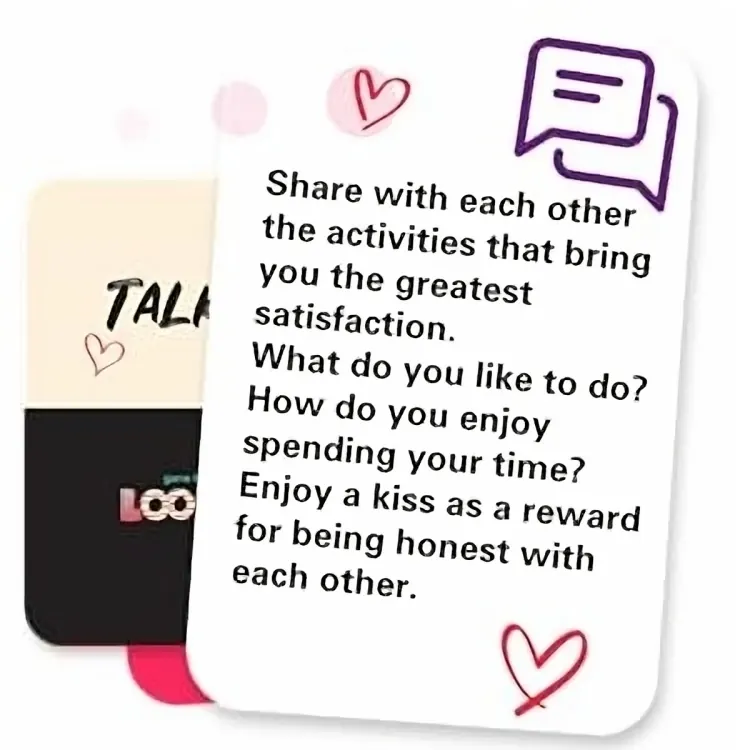
Loopy Game for Couples is the deck we make and sell here, and it is a progressive game for two rather than a single pile of prompts. It runs through five named stages, Talks, Fun Activities, Kisses, Fondles and Secret, with a board that paces the evening so the night has a shape instead of a random draw. The set sells for $29, ships in discreet packaging, and the intimate deck only comes into play if you both choose it. Full disclosure: I co-created Loopy with that drawer problem in mind, so weigh my enthusiasm accordingly. You can read the full breakdown on the Loopy game page, or browse everything we cover on the games hub if you want to compare formats first.
What if you own no cards at all tonight?
With no cards at all, you can still run a full date night, and honestly you should try it before spending anything. Two truths and a lie with the obvious answers banned, a question ladder that gets one notch more personal each round, a blind taste test from your own pantry.
Our list of date night games at home has fifteen of these, sorted by how much energy they need. If talking is the whole plan, start with our conversation starters that go deeper than small talk, which climb from easy openers to real questions. If a no-prep version of the evening lands well, a deck will land better. If it does not, the deck was never the problem.
FAQ
Are couples card games only for new relationships?
No. Couples card games arguably do more for long-term partners, because new couples still have plenty of unasked questions and ten-year couples have run out of them. What changes is the deck: look for prompts about memory, plans and preferences that shift over time rather than getting-to-know-you basics.
How many cards is enough?
A couples card game needs enough distinct prompts to survive at least five or six evenings, which in practice means well over a hundred cards for a talking deck. Small decks are fine as a gift or a stocking filler. They are a poor choice if you want a recurring date night ritual.
What if one of you does not like games?
Pick a conversation deck and drop the rules. Plenty of question-based couples card games work perfectly well as a stack you draw from over dinner, with no board, no scoring and no winner. The reluctant partner is usually objecting to competition, not to talking.
Can you play a couples card game long distance?
Yes, if the deck is question-led. One partner holds the cards and reads them aloud on a video call, or you both use a free browser-based version. Dare-based and physical decks are the ones that do not translate, so check our online games picks instead.
If the deck is for a specific date rather than a general one, our anniversary game night guide shows how to build the evening around it, including which round to play the deck in.
Buying for another couple is a harder call, because you are guessing at their taste. Our guide to gifting a couples game sorts that out by couple type and by who is doing the giving.
“Overall, playfulness may facilitate positive experiences in relationships and help couples embrace the lighter side of life.”
René T. Proyer, professor of personality psychology at Martin Luther University Halle-Wittenberg, writing with Kay Brauer in 2019
Buy the deck that matches the night you actually want to have. That is a smaller decision than the review pile makes it look, and the worst outcome is one quiet evening spent talking instead of scrolling.