Conversation Starter Questions That Go Deeper Than Small Talk
Conversation starter questions go deeper than small talk when they ask for a story or an opinion instead of a status update. “How was work?” gets you “fine.” “What part of today would you delete if you could?” gets you ten minutes and something you did not know. That shift is small. It changes the whole evening.
“Open-ended questions are questions that have a whole story as an answer.”
Julie Schwartz Gottman, co-founder of The Gottman Institute, speaking to KUOW in 2014
Why do deeper conversation starters work better than small talk?
Deeper conversation starters work better than small talk because they ask your partner to reveal something, and a little mutual revealing is what makes two people feel close. This is not just a hunch. One of the best-known experiments in relationship psychology tested that idea directly, and it is the reason the “36 questions” exist.
In a study published in Personality and Social Psychology Bulletin in 1997, psychologist Arthur Aron and his colleagues had pairs of strangers spend about 45 minutes on self-disclosure tasks that slowly escalated in intensity, a set now known as the “36 questions.” Those pairs reported feeling closer afterwards than pairs given comparable small-talk tasks.
Two things from the Aron study are worth stealing. The questions got more personal gradually, not all at once. And both people answered every question, so nobody sat in the hot seat alone. Keep both in mind and most of the awkwardness takes care of itself.
Level 1: easy openers that still beat “how was your day”
Level 1 conversation starters are light questions that ask for a story, which makes them safe for a tired Tuesday. No one has to be brave. You just have to be curious.
- What is something small that made you happy this week?
- If we had a free Saturday with no chores, what would you actually want to do?
- Which meal from your childhood would you order right now?
- What is a skill you pretend not to care about but secretly want?
- What was the best conversation you had with a stranger?
Level 1 questions also slot neatly into a Friday couch debrief, one of the low-energy rituals for reconnecting after a busy week that still work when neither of you has much left to give.
Level 2: questions about how your partner thinks
Level 2 conversation starters ask about opinions, habits and memories, and this is where you start learning things even after years together. People change. The version of your partner who answered these questions five years ago is not the one sitting across from you now.
- What is something you believed at 20 that you have completely changed your mind about?
- When do you feel most like yourself?
- What is a compliment you got once and still think about?
- Which of your friends do you think understands you best, and why?
- What is a moment from our first year together that you remember and I probably forgot?
Level 3: the deep end
Level 3 conversation starters touch fears, hopes and the relationship itself, so save them for a night when you both have energy and no deadline. I would not open with these. Work up to them, the way the Aron study did.
- What is something you have never told me because you were not sure how I would react?
- What does a good life look like to you in ten years, in detail?
- Is there a way I show love that you do not always notice, or one you wish I did more?
- What is a fear you have that seems silly out loud?
- What is one thing we do as a couple that you never want us to lose?
The first time Ben and I tried this list at our kitchen table, we got through two questions in an hour and a half. I count that as a win.
Which conversation starter level fits tonight?
The right conversation starter level depends on your energy and your setting more than on how long you have been together. A couple married twenty years can need Level 1 on a Thursday, and a couple three months in can handle Level 3 on a quiet Sunday. Use this table as a shortcut.
| Level | Best moment | Setting | Time needed |
|---|---|---|---|
| Level 1: easy openers | Weeknights, road trips, both tired | Car, kitchen, walking the dog | 5 to 15 minutes |
| Level 2: how you think | Dinner out, slow weekend mornings | Restaurant, couch, coffee | 20 to 40 minutes |
| Level 3: the deep end | Anniversaries, a calm night with no plans | Home, phones in another room | 45 minutes or more |
How do you ask deep questions without it feeling like an interview?
Deep questions feel natural when you answer them too, follow up on what you hear, and let one good question fill the night. Rapid fire kills it. If your partner gives a real answer, the best next question is almost always “what happened next?” or “why do you think that stuck with you?”, not the next line on the list.
That follow-up is a small way of turning toward your partner. According to the Gottman Institute, newlyweds who were still married at a six-year follow-up had turned toward each other’s bids for connection 86% of the time, while couples who divorced averaged 33%.
Still in the first few dates? Start lighter: our guide to icebreaker games for early dates covers quick games that warm things up before the deep questions.
A few house rules help:
- Both answer. Take turns going first.
- Pass is allowed. Anyone can skip a question, no explanation needed.
- No fixing. If your partner shares a worry, listen first. Advice can wait until it is asked for. This is the rule Ben and I break most.
- Phones away. Face down still counts as present. Another room works better. In a 2019 Pew Research Center survey, 51% of partnered US adults said their partner is often or sometimes distracted by a cellphone while they are trying to talk.
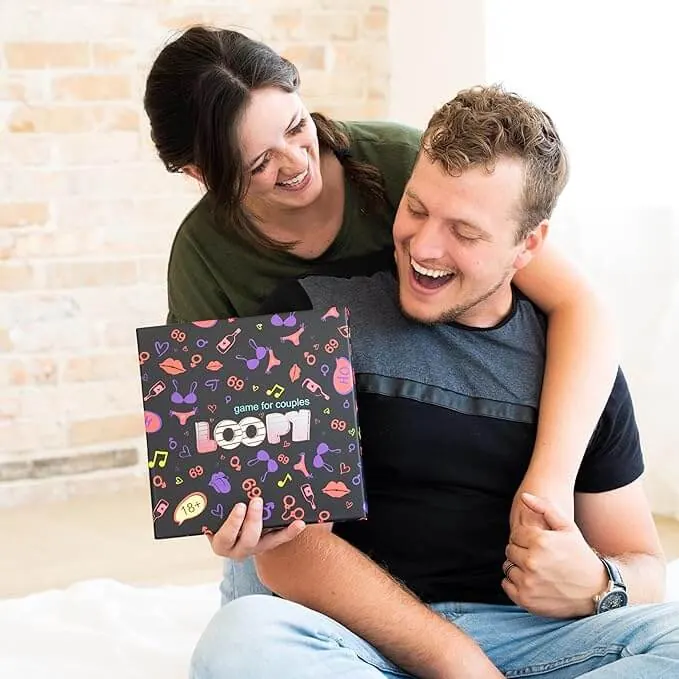
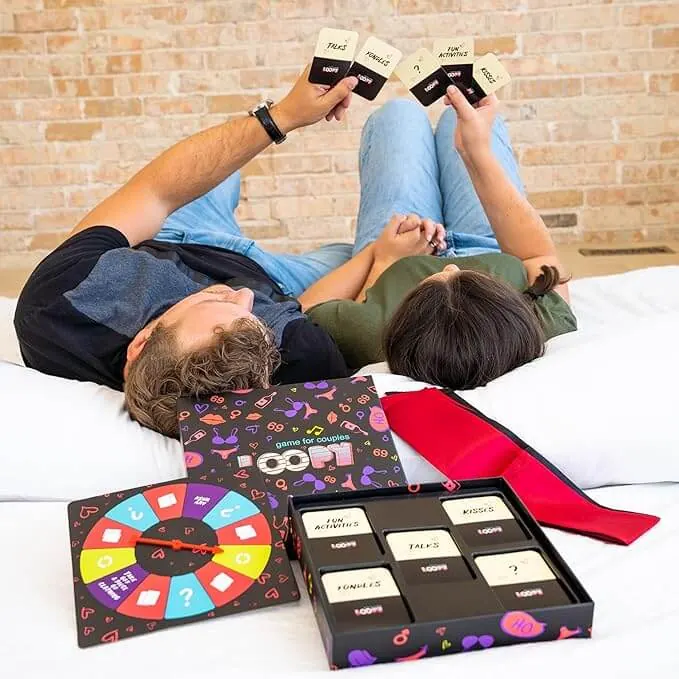
If reading questions off a phone feels too much like homework, a deck does the job with less friction. Drawing a card makes the question feel like part of a game rather than something you prepared. The LOOPY game for couples has a Talks deck built for exactly this, sitting next to lighter activity and flirty decks so you can mix moods in one night. Our guide to choosing a couples card game explains how pass rules and prompt levels differ between decks, and the question games for couples page has game formats built around asking and answering.
If you would rather buy a deck, here is what a few question decks hold:
| Question deck | What is inside | Players | Price (October 2026) |
|---|---|---|---|
| We’re Not Really Strangers, Couples Edition | 150 cards in 3 levels, plus wildcards | 2 | $20 |
| Let’s Get Deep (Relatable) | 200 cards: Ice Breaker, Deep and Deeper levels, plus activity cards | 2 or more | $21.99 |
| BestSelf Intimacy Deck | 170 questions in 7 topic categories | 2 | $27 on sale ($30 list) |
| Loopy | A Talks deck plus four activity and flirty decks, spinner board, blindfold | 2 | $29 |
Want to turn the talk into a whole evening? Pair a Level 2 round with one of the ideas in date night games at home, or browse everything we stock in the shop.
Dating across cities or time zones? The same questions work over a call, and our guide to games for long-distance couples shows how to turn them into a proper date night on a screen.
Want to turn these questions into a scored game? Our guide to running a “how well do you know me” couples quiz shows how to set it up so it stays playful.
FAQ
What is a good conversation starter for couples who have been together a long time?
A good conversation starter for long-term couples asks about change, like “what have you changed your mind about in the last few years?” Long-term partners already know the facts about each other. What they often miss is how the other person’s opinions and hopes have shifted.
Are the 36 questions a good date night activity?
The 36 questions from the Aron study can make a good date night, as long as you treat them as a slow conversation and not a test. They were designed for strangers, so some early questions will feel basic to a couple, and it is fine to skip ahead.
What if my partner does not like deep conversations?
If your partner is not a fan of deep conversation, start with Level 1 questions and a playful format like a card game, and let them set the pace.
How many questions should we ask in one night?
Three to five good questions is plenty for one night. One question that turns into a twenty-minute story is a better result than twenty questions answered in a sentence each.